RDA and Daily Value are related nutrition terms, but they are not the same thing. Understanding the difference makes Supplement Facts panels easier to interpret and helps prevent the common assumption that “100% Daily Value” is a personalized target for every person.
What does RDA mean?
RDA stands for Recommended Dietary Allowance. The National Academies develops RDAs as part of the Dietary Reference Intakes. An RDA is the average daily intake level considered sufficient to meet the nutrient needs of nearly all healthy people in a particular age, sex, or life-stage group.
That last point matters: there is not always one universal RDA. Nutrient recommendations can differ for children, adults, men, women, pregnancy, and lactation.
What is Daily Value?
Daily Value (DV) is the reference amount used on U.S. Nutrition Facts and Supplement Facts labels. Percent Daily Value (%DV) shows how much a serving contributes to that labeling reference amount.
DV is designed to make labels easier to compare. It is not necessarily identical to the RDA for your age or life stage, and it is not a prescription for how much of a nutrient every individual needs.
Does 100% Daily Value mean “the perfect amount”?
No. A product providing 100% DV can be useful as a label reference, but nutrition needs depend on the nutrient and the person. Some nutrients do not have an established Daily Value, while others may appear above or below 100% DV in a supplement. More is not automatically better; some nutrients have tolerable upper intake levels, and high supplemental doses can be inappropriate in certain situations.
How to compare supplement labels
- Check serving size. A bottle may list amounts for more than one capsule or tablet.
- Read the amount per serving. Do not rely on %DV alone.
- Look for the ingredient form. Different forms can have different characteristics.
- Consider your total intake. Food, fortified foods, and multiple supplements can all contribute the same nutrient.
- Review cautions. Medications, health conditions, pregnancy, and other factors can change what is appropriate.
Where vitamin and mineral supplements fit
Vitamin and mineral supplement formulas vary widely. Some aim to provide broad nutrient coverage around Daily Values, while others contain targeted doses or additional ingredients. If you are comparing formulas, use the Supplement Facts panel as the primary source rather than assuming all formulas are equivalent.
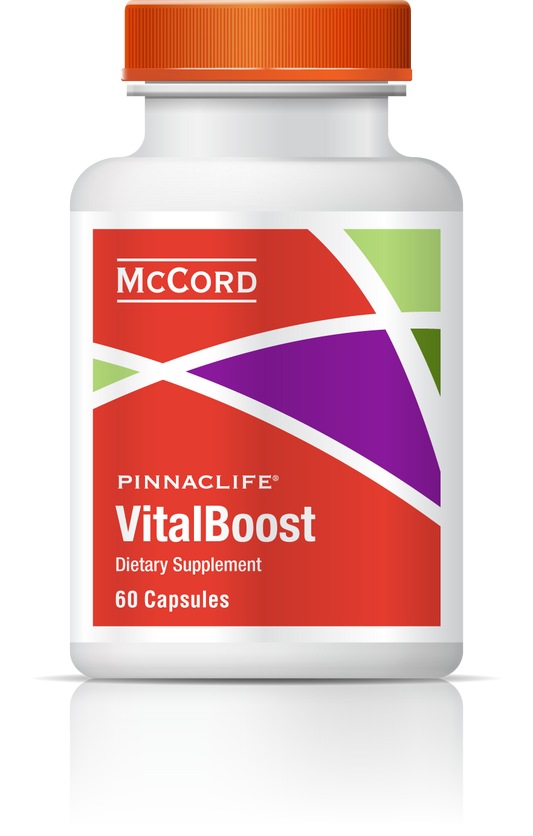
You can review the label for VitalBoost Vitamin & Mineral Supplement or compare McCord Health supplements.
Bottom line
RDA is a population-specific nutrient recommendation; Daily Value is a standardized labeling reference. Knowing which one you are looking at makes supplement labels more useful and reduces the temptation to treat a single percentage as a personalized nutrition plan.
Sources and further reading
- National Institutes of Health Office of Dietary Supplements: Dietary Reference Intakes and nutrient recommendations.
- U.S. Food and Drug Administration: Daily Value and Supplement Facts labeling resources.
This article is for general educational purposes and is not medical advice. Talk with a qualified healthcare professional if you have questions about your individual nutrient needs or supplement use.